
Most of us know what a good bedtime routine looks like. You’ve read the lists: no screens after 9, herbal tea, meditation, a journal, stretching, reading a chapter of a book, a warm bath, dim candles. Then real life shows up — the baby wakes at midnight, a work shift runs late, the bedroom is tiny and doubles as an office — and the whole beautiful plan collapses by night two. By the end of the week, the routine feels like one more thing you failed at, and sleep gets worse, not better.
Here’s the truth the glossy checklists skip: a bedtime routine works because of repetition, not because of any single activity. Your brain is a pattern-recognition machine. When you do roughly the same calming things in roughly the same order each night, your body starts to associate that sequence with sleep. The lights dim, the pace slows, and your nervous system takes the hint. That’s it. There is no magic tea or perfect app. Consistency matters far more than perfection — a simple ten-minute routine you actually do every night will beat a gorgeous sixty-minute ritual you abandon by Thursday.
This guide is about designing a wind-down routine you can genuinely sustain. We’ll start with the one decision that makes everything else easier — your wake time — then walk through a sample 30-to-60-minute wind-down sequence you can shrink or stretch. We’ll cover how to adapt the routine when life isn’t cooperative: shift workers, parents of small children, people in small shared homes. And we’ll end with troubleshooting, because even the best routines fall apart sometimes, and what you do the morning after a bad night matters more than the bad night itself.
One more thing before we begin: this article is for general wellness education. Sleep problems can be symptoms of medical conditions, and nothing here replaces a conversation with a qualified health professional if you regularly struggle with sleep.

Start with Your Wake Time, Not Your Bedtime
Almost every bedtime article starts by telling you what time to go to bed. This one starts somewhere else, because your wake time is the anchor of your entire sleep schedule. Your body’s internal clock — the circadian rhythm — locks on to consistency, and it’s far easier to make your wake time consistent than your bedtime. Bedtime is at the mercy of traffic, deadlines, dinner parties, and restless toddlers. Wake time is usually the one part of the day you can actually control.
Pick a single wake time and stick to it seven days a week, or as close as you can get. Yes, that includes weekends. The research on this is quite consistent: people who keep their sleep schedule steady — waking within about an hour of the same time every day — tend to report better sleep quality and more daytime alertness than people who swing wildly between weekdays and weekends. That weekend “sleep catch-up” where you sleep in two or three hours feels restorative, but it works a lot like jet lag. Your body has to re-adjust on Monday, and the whole week starts with a small groggy debt.
Once your wake time is fixed, your bedtime takes care of itself. Most adults need roughly seven to nine hours of sleep. Count backwards from your wake time and you’ll find your bedtime window. If you need to be up at 6:30 and you function best on eight hours, you’re in bed around 10:30. That’s not a commandment — it’s a target zone. Some nights you’ll land it, some nights you won’t, and that’s fine. The wake time is the non-negotiable; the bedtime is the aspiration.
The first week of a fixed wake time can feel rough, especially if you’ve been sleeping in on weekends for years. Your body may need a few days to believe you. Give it at least a week before judging the experiment. An alarm across the room helps — the small act of getting up to silence it makes crawling back under the covers slightly less automatic. And the moment you get up, light is your best friend: open the curtains, step outside for a minute, or sit near a bright window. Morning light is the strongest signal your circadian clock has.
Why Consistency Beats the Perfect Routine
Think of two imaginary people. Priya has a perfect routine: lavender oil, a meditation app, a gratitude journal, and chamomile tea. She does it four nights out of seven — on the nights she’s not too tired, not too busy, and not binge-watching something. Rahul does exactly three things every single night without exception: he brushes his teeth, changes into sleep clothes, and reads five pages of a novel with the room lights dimmed. That’s all. Rahul’s routine is objectively less impressive. It is also, almost certainly, working better.
The science of sleep is clear on this point: regular sleep patterns are strongly associated with better sleep quality and daytime functioning, more so than any individual pre-bed activity. The cue-response link your brain builds — dim light plus quiet activity plus horizontal body equals sleep — only forms through repetition. Every time you run the sequence, the signal gets a little stronger. Every time you skip it, the signal weakens. The activity itself is almost interchangeable; the repetition is the active ingredient.
This is actually liberating news. It means you can stop hunting for the perfect wind-down activity and start thinking about the minimum viable routine — the shortest sequence you could do on your worst, most exhausting night. Design for that night. If the routine survives your worst night, it will survive every night. A routine that only works on calm evenings is a hobby, not a habit.
It also means you can release the guilt. Skipping a step is not failure; breaking the pattern for a week is what costs you. If you do two out of three steps on a rough night, you have kept the signal alive. If you did nothing for three nights because travel wrecked your schedule, that’s what troubleshooting sections are for. Progress, not perfection, and the research backs that framing completely.
Choosing Activities That Actually Calm You
Not every “calming” activity calms every person. Reading relaxes some people and winds up others, especially if the book is a thriller with a cliffhanger at the end of every chapter. Journaling unloads some minds and gives others a fresh list of things to worry about. The goal of the wind-down window is to lower your body’s arousal level — heart rate down, muscle tension down, racing thoughts slowing. You get to pick how you get there, as long as it genuinely gets you there.
A good test is simple: after ten minutes of the activity, do you feel slower than when you started? That’s it. If scrolling through property listings makes your brain buzz, it’s out. If stretching on the floor makes your shoulders drop, it’s in. Common choices that work for many people include light reading (paper books or e-readers with the light low), gentle stretching, a warm shower, tidying one small area, or sitting with a hot drink and doing nothing in particular. Doing nothing in particular is an underrated wind-down activity.
What to avoid is anything that raises your alertness or floods you with light. Intense exercise, heated arguments, work email, and doomscrolling are the usual suspects. This doesn’t mean you must banish screens entirely — a short video call with family isn’t the same as forty-five minutes of a glowing feed an inch from your face. But screens deserve special attention: many emit bright blue-toned light, and the content is engineered to hold your attention, which is the opposite of winding down. If your phone is your wind-down tool, turn the brightness down, use night mode, and set a firm stopping time rather than falling asleep mid-scroll.
Keep the routine to two to four activities. Three is the sweet spot. Any more and it starts to feel like a second job; any fewer and the sequence doesn’t feel like a sequence. Write your chosen steps on a card and keep it on your nightstand for the first month. Not because you’ll forget, but because the card removes the nightly decision of “what do I do now?” Decision fatigue is the silent killer of routines.

A Sample 30-to-60-Minute Wind-Down Sequence
Here’s a template, not a prescription. Read through it, then steal the structure and swap in your own activities. The logic is simple: the sequence moves from the busiest, most active end of your evening toward stillness. Each step is slightly quieter and dimmer than the last, so your body descends gradually instead of slamming from “answer emails” to “please sleep now.”
Start sixty minutes before your target sleep time. If that’s 10:30, your wind-down begins at 9:30. Set a quiet alarm or a gentle reminder on your phone — something that says “wind-down starts now” without shrieking. The first five minutes are logistics: phone to the charger outside the bedroom (or at least across the room), tomorrow’s essentials laid out, and one quick sweep of anything that would nag at you — did I lock the door? Is the lunch packed? Anything that would send you springing out of bed later, handle now.
The next twenty minutes are for one active-but-calm task. This is the stretch or the warm shower or the tidy-up or a slow walk around the block. The key word is unhurried. You’re not exercising to a burn; you’re moving gently, breathing slowly, and letting the day’s tension drain out of your muscles. A warm shower is particularly useful here because the drop in body temperature afterward mimics the natural cooling your body does as it prepares for sleep.
Then comes the middle phase, around twenty minutes: the quiet activity. Sit down somewhere comfortable with your book or your drink or your journal. Dim the lights now if you haven’t already — switch off overhead lights and leave only a warm lamp. This is the heart of the routine, the part your brain will come to associate with sleep. Keep it boring in the best way. The content should interest you just enough to keep you engaged but never enough to make your heart race.
The final ten minutes are the sleep bridge. Get into bed. Same side of the bed, same pillow arrangement, as much sameness as you can manage. A few slow breaths — inhale through the nose for a count of four, exhale through the mouth for a count of six — tell your nervous system the day is officially over. If thoughts are spinning, try the old trick of giving them a parking lot: a notebook by the bed where you scribble tomorrow’s worries in one line each, then close the book. The worry hasn’t vanished, but it’s been filed.
Shortening It to Fifteen Minutes on Busy Nights
Some nights, sixty minutes is a fantasy. You get home at 11, or the baby finally sleeps at 10:45, or the shift ran two hours long. This is where the minimum viable routine saves you. Shrink the sequence to its skeleton: one calming activity, the light change, and the sleep bridge. Fifteen minutes, three moves.
For example: teeth and face (five minutes), change into sleep clothes and dim everything down to one warm lamp (three minutes), then seven minutes in bed with slow breathing or a few pages of a book. The order stays the same every time — that’s what keeps the cue intact. The brain doesn’t check the duration; it checks the pattern. Same order, same signals, just compressed.
The critical rule of the short version: never skip the light change. Dimming the lights is the single most powerful circadian signal in your routine, and it costs you nothing. Even in a shared flat or a small room, you can switch off the main light and leave a low warm lamp on. It’s the one step that does the most work for the least effort, and on chaotic nights, it’s the anchor that keeps the whole routine recognizable to your body.
Resist the temptation to “make up” a skipped routine by doing extra the next night. Routines don’t work like bank accounts — you can’t deposit a double session and earn interest. Just run the normal version tomorrow. The system is designed to be forgiving. One bad night is a data point, not a verdict.
Stretching It to a Full Hour on Relaxed Evenings
On nights when time is plentiful, the same skeleton stretches gracefully. Give each phase more room: a longer walk, a proper warm bath instead of a quick shower, a full chapter instead of five pages. The sequence stays identical — you just linger in each stage. There’s no prize for inventing new steps. Adding steps actually risks the opposite: a routine that only works on luxurious evenings trains your brain to associate sleep with luxury, and luxury is in short supply.
Use the extra time for the activities you never quite fit on busy nights. This is a good slot for the slightly longer journal entry, the ten-minute stretch routine, or preparing something nice for tomorrow morning — laying out clothes, prepping breakfast, tidying the kitchen so you wake to order instead of chaos. Preparing for tomorrow is a legitimate wind-down activity, by the way. It converts vague morning anxiety into completed tasks, and a calmer morning makes tomorrow night’s routine easier to keep.
One caution: don’t let the relaxed evening turn into a revenge-bedtime-procrastination evening. That’s the phenomenon where you stay up late scrolling or streaming because the day gave you no personal time, and you “reclaim” it at night. If you notice your relaxed evenings ballooning past your bedtime window, it’s often a sign that your days need more breathing room — a walk at lunch, ten minutes of music after work — so your nights don’t have to carry the entire burden of your leisure.
Adapting the Routine for Real Life — and Recovering When It Breaks
The sample sequence above assumes a standard evening in a standard home. Plenty of readers don’t have that. Shift workers sleep when the sun is up. Parents sleep in fragments. People in small homes share bedrooms with partners, children, or flatmates, and the idea of a “quiet wind-down corner” is a joke. A routine that can’t bend to these realities isn’t a routine — it’s a wish. So let’s bend it.
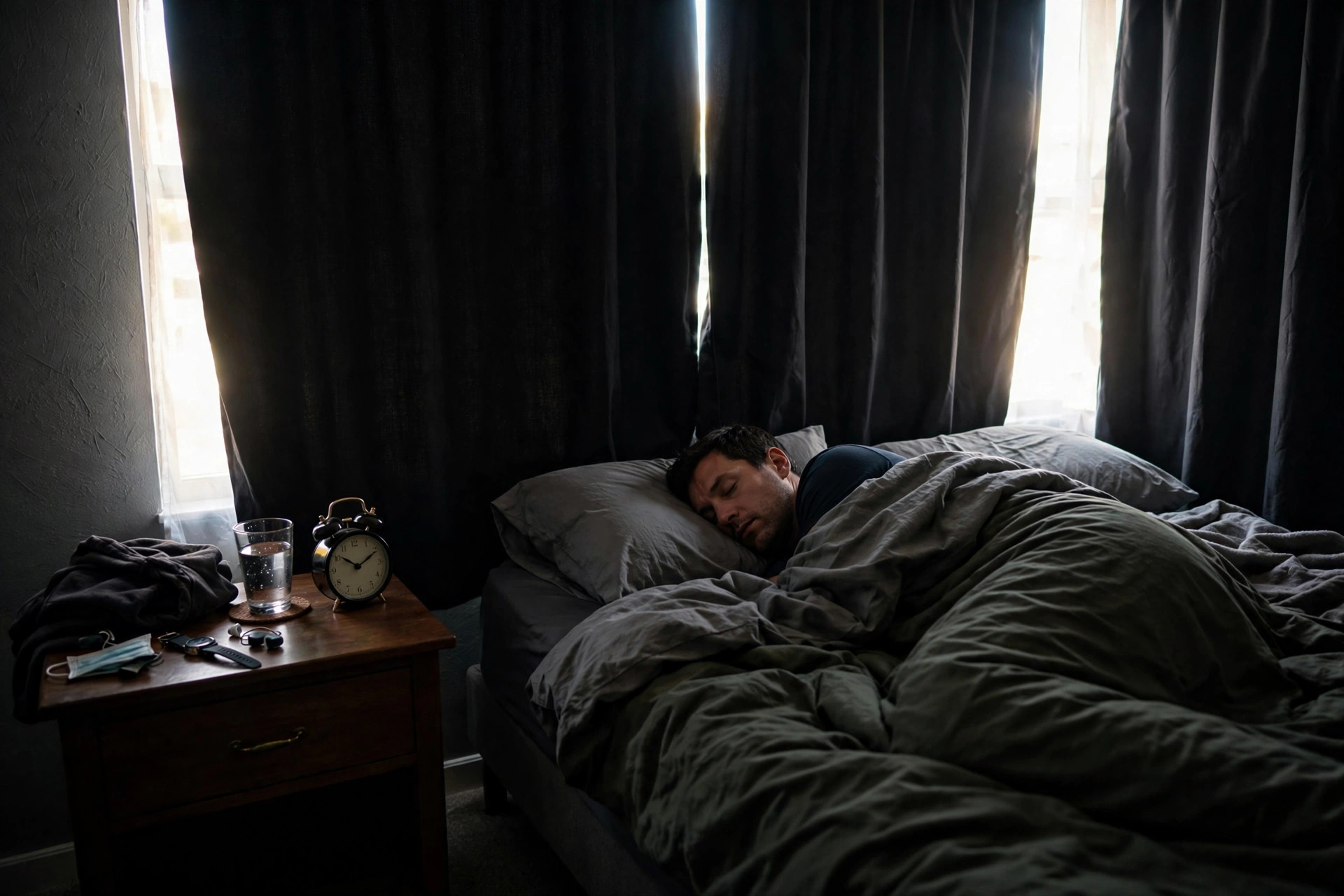
The principles don’t change: fixed wake time (adjusted to your shift), same-order sequence, dimming light, and a calming bridge to sleep. Everything else is negotiable. A nurse finishing a night shift at 7 a.m. can run the exact same 30-minute sequence in the morning — shower, dim room, quiet reading, bed — and it will work just as well, because the brain cues on the pattern, not the clock. The one extra requirement for daytime sleepers is darkness: blackout curtains or a sleep mask, because morning light is a powerful wake-up signal that fights your routine.
Parents of young children can build the routine around the child, not despite them. The bedtime sequence for the child and the wind-down for the parent can share their final steps: lights low in the house after the child is down, a quiet activity, then bed. If your child wakes in the night, don’t abandon the routine — return to bed and run the sleep bridge (slow breathing, same position) for a few minutes. You’re re-cueing the pattern rather than starting from scratch.
Small homes need creative light control. You may not have a bedroom at all — just a corner of a studio. That’s fine. The routine is about signals, not square footage. A specific lamp that you only switch on for wind-down, a blanket that only comes out at bedtime, earplugs or a sleep mask that mark the transition — these are portable cues. When space is shared, talk to your flatmates or partner about the wind-down window: “From 10 to 10:30 I’m dimming lights and keeping it quiet” is a reasonable request, and most people will respect it once they understand it’s about sleep, not rules.
For shift workers, the fixed-wake-time advice needs a modification: keep one consistent wake time per shift pattern, and change it as little as possible when you rotate. Rotating between days and nights is genuinely hard on the body — no routine fully erases that — but a stable pattern within each rotation still helps enormously. When you switch from nights to days, give yourself a transition day and shift your wake time in steps of an hour or two rather than all at once.
Light management is your superpower. On the way home from a night shift, wear sunglasses to block the morning light that would otherwise tell your brain to wake up. At home, make the bedroom as dark as a cave: blackout curtains, tape over LED lights, a sleep mask as backup. Keep the room cool and quiet — earplugs or white noise if the neighbourhood is awake and noisy. Then run your wind-down sequence exactly as written. The darkness plus the familiar sequence is a convincing impersonation of night, and your body will increasingly buy it.
Talk to your family or housemates about your sleep window. Shift workers often suffer not from bad routines but from a household that doesn’t know when they’re sleeping. A simple shared calendar or a “sleeping — please keep it down from 8 to 2” sign on the door prevents most interruptions. Protecting daytime sleep socially is just as important as blacking out the windows physically.
Parents often say their wind-down starts only after the children are asleep, leaving a window of maybe twenty minutes before exhaustion takes over. Twenty minutes is enough. Run the compressed version: quick tidy of whatever would nag you, dim the house lights, ten minutes of something genuinely pleasant (not chores, not phone admin), then bed. The pleasantness matters — if the only “me time” in your day is the wind-down, make it actually feel like yours, or you’ll resent the routine and start staying up late to reclaim your evening.
In small or shared homes, sound becomes the cue instead of space. A short playlist of the same calm tracks, a white-noise app, or simply the ritual of putting in earplugs can mark the transition as clearly as a separate room. If your partner keeps different hours, negotiate the light: a sleep mask for you is cheaper than an argument. If children share the room, the routine can be shared too — a family wind-down where everyone dims down together teaches the pattern to the whole household.
The deeper point for parents and small-home dwellers: don’t compare your routine to the magazine version. The magazine version assumes a spare bedroom and a silent house. Your version assumes real life. A fifteen-minute routine kept for a year beats a sixty-minute routine kept for a week, and it isn’t close.
Even the best routine breaks sometimes. Travel, late nights, illness, a restless mind, a power cut, a neighbour’s party — something will break the sequence, and when it does, the goal shifts from maintaining the routine to recovering it. How you handle the disruption matters far more than the disruption itself. One bad night does not create a sleep problem. Panicking about one bad night, and then lying awake the next night worrying about sleep, is how bad nights multiply.
Start with the morning after. This is the most important sentence in this section: keep your wake time. Get up at your usual hour even if you slept badly. Yes, you’ll be tired. But sleeping in resets your clock and pushes the next bedtime later, and that’s how one late night becomes a late week. Get up, get light, move a little. A short walk in the morning does more for tonight’s sleep than an extra hour in bed this morning.
Then run the routine normally that evening. Don’t add extra steps to compensate. Don’t go to bed two hours early — that usually backfires, because you lie awake and teach your brain that bed is a place for tossing. Go to bed at your normal time, run your normal sequence, and trust the pattern. It has been reinforced dozens or hundreds of times; one interruption doesn’t erase it.
For travel, pack a portable version of your cues. A sleep mask and earplugs weigh nothing and recreate your light and sound environment anywhere. Keep one familiar element of the routine — the same book, the same breathing count, the same playlist — because familiarity is the cue. Try to keep your home wake time if the time zone difference is small, or shift gradually if it’s large. And be patient: it typically takes about a day per time zone crossed for your body clock to fully adjust.
For restlessness — the lying-awake kind — use the twenty-minute rule. If you’ve been awake in bed for around twenty minutes and sleep feels further away, get up. Go to another room, keep the lights low, and do something dull: fold laundry, read something boring, listen to calm audio. Return to bed only when you feel sleepy. This isn’t giving up; it’s protecting the association between bed and sleep. A bed you toss in for an hour becomes a bed your brain associates with tossing. Guard that association jealously.
When the Routine Falls Apart: The Two-Day Recovery Rule
Here’s a simple framework for getting back on track after any disruption: give yourself two days. Day one is damage control — keep the wake time, don’t nap too long (twenty minutes max, before mid-afternoon), get daylight, and run the routine that evening. Day two is the test — by the second morning on your normal schedule, most people feel the rhythm returning. If after several days of normal routine you still can’t fall or stay asleep, that’s useful information, and it’s worth discussing with a health professional rather than white-knuckling it alone.
What you should not do in those two days: reach for sleep aids you haven’t discussed with a doctor, binge caffeine to compensate (cut it off by early afternoon), or turn the bad nights into a story about yourself — “I’m just a bad sleeper.” Identity statements become self-fulfilling. You’re a person whose routine got disrupted, which is a temporary and fixable situation, not a character trait.
Keep a one-line sleep log during recovery — wake time, rough bedtime, and a one-to-ten rating of the day’s energy. Not forever; just for the rough patch. It turns vague misery (“I’ve been sleeping terribly for weeks”) into data (“three bad nights, then back to normal”), and data is calming. It also gives you something concrete to show a professional if you ever need one.

The quiet promise underneath all of this: routines are resilient. They bend, they pause, they restart. The people with the best sleep aren’t the ones who never miss a night — they’re the ones who know exactly how to get back on track when they do. Build the routine for your real life, keep it simple enough to survive your worst night, and trust the pattern to carry you through the rest.
Sources and further reading
The sources listed here back up the general health information in this guide. The examples and daily routines are practical illustrations — not personal medical advice.
This article is for general education only. It was created with AI assistance and has not been clinically reviewed. For guidance about your own situation, please speak with a qualified health professional.