Full Body Exercises: If we knew about a workout that engaged the entire body, there would be no better option; however, beginners often realize this only later and then regret it. But today, we will discuss several such full-body workFull-Body Workouts at Home: With and Without Equipmentouts that can help you get stronger, lose fat, and build muscle in a short amount of time.
Let’s talk about workouts that you can do at home, in a park, at the gym, or in any open space where you feel comfortable. There are no restrictions on these workouts; both men and women can do them—they are not limited to any specific gender.
We will also discuss workouts that can be done with equipment and others that require none, so you can choose what suits you best. This boosts your confidence and leads to better results. Simply follow these workouts.
Why You Need a Full Body Workout?
First of all, a 20–30 minute full-body workout activates your entire body. It is a great option for saving time, as you can do a full-body workout at home whenever you like. If you do it regularly, you won’t regret it.
Maintaining one’s fitness is a dream for everyone, and having a sound strategy is essential for achieving it. A full-body workout is an excellent option in this regard, as it delivers high results in a short amount of time while also improving your weight, height, appearance, and physical strength.
Benefits of Full-body Workouts
It helps improve your overall physique and heart health, build muscle, and maintain stamina. If you fail to sustain this, these benefits will diminish over time and have a negative impact on your body in the future.
A prime example of this is athletes; whenever they play a sport, they start with a 30-minute full-body workout to loosen up their muscles and ensure every part of their body functions effectively.
Regular full-body training improves stamina, balance, and flexibility while also boosting heart health and metabolism. These workouts, which can be performed at home with minimal equipment, are suitable for both beginners and experienced individuals, helping to maintain overall fitness while keeping the body active and energetic.
Full Body Workouts at Home: With and Without Equipment
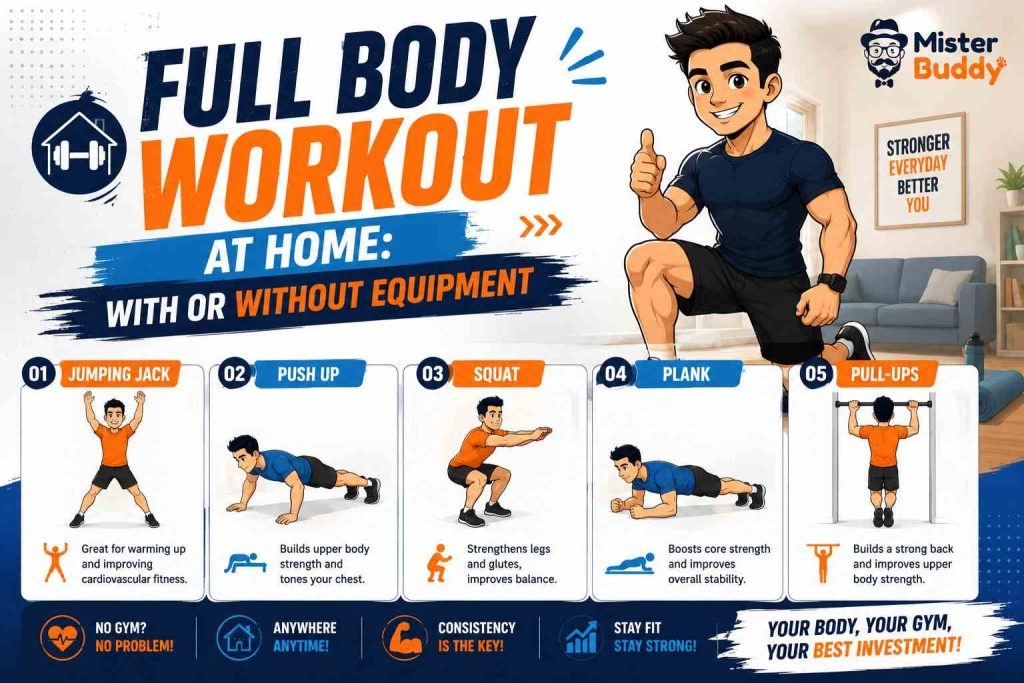
Both full-body workouts—with and without equipment—are effective; the extent of the positive results depends on the individual’s body. There are numerous benefits as well; for instance, it helps burn body fat, keeps your heart and lungs healthy, and helps alleviate issues like anxiety and depression.
Jumping Jack
This is a full-body workout that helps correct your body’s structure and improves blood flow to the heart without obstruction. It targets your core muscles (such as those in the legs, arms, and shoulders), burns fat and calories, and yields effective results.
For this exercise, posture is simple; you just need to jump while spreading your arms, much like the PT exercises done in school. You perform three sets of 2–3 minutes each, and your entire body becomes fully active.
Push up
Among exercises that require no equipment, the most popular one is the exercise that focuses more on your chest and back than on other parts of the body. This push-up exercise can be somewhat challenging for beginners.
For this exercise, you lie down with both hands placed on the ground and then push yourself up using them. This exercise rapidly boosts blood flow throughout your body and effectively targets the muscles in your chest, back, and core. Several variations of this Exercise—such as knee push-ups, incline push-ups, and diamond push-ups—can be adopted according to different fitness levels.
Squat
Squats are very popular among men because they effectively target the glutes and legs—areas that are difficult to develop without this specific exercise. To increase the intensity, you can hold weight plates in your hands, which leads to better performance.
This exercise engages multiple muscle groups, such as the legs, back, and core. To perform it, simply stand upright with your feet shoulder-width apart. Keeping your back straight, push your hips back and bend your knees to lower yourself into a squat, then rise back up, pushing through your heels.
Plank
This is a fairly simple exercise; it simultaneously engages multiple muscle groups—including the abdominals, lower back, shoulders, chest, and glutes—thereby improving body stability, balance, and posture.
The technique for this is quite simple: lie on your stomach and lift your body, supporting yourself on your elbows and toes. Keep your body straight from head to heel, engage your core like abs, back, and hold the position for the designated time. Performing three sets of two minutes each will yield good results.
If you want to take this to the next level, place 5 or 10 kg weight plates on your back; having your body carry the extra weight will engage your muscles more effectively.
Pullups
This is an exercise requiring equipment; you need a pole or bar that you can hang from. Grip the pull-up bar with your hands spaced slightly wider than shoulder-width apart. Pull your body up until your chin clears the bar, then slowly lower yourself back down.
There are several ways to perform this exercise; beginners can start using assisted pull-ups or resistance bands, while experienced individuals can increase the difficulty through various variations. The greater the difficulty, the faster our muscles grow.
Some Important FAQs
Do full-body workouts help with weight loss?
Yes, a full-body workout certainly helps in shedding excess weight because it engages all your muscles; for instance, squats work on your legs, lower back, and so on.
Can I do a full-body workout at home without equipment?
Yes, in a full body workout there are many exercises that you can do without equipment, like jumping jacks, plank, squits etc all exercises. Good for boosting your body’s health
How many times a week should I do full-body workouts?
For good results, you should train your muscles with a ‘full-body workout’ at least four times a week; however, doing it six times a week with a one-day break certainly yields excellent results.